NOTE: This is a speech that I wrote for FFA Contest for Sub-Districts 2011. Sources are at the bottom of the page.
NOTE: Pictures of the different dwarf types are at the bottom of the page.
Dwarfism in Horses
Breeding horses is often described
as Russian Roulette. With the desired parents, a breeder often times has the
chance of producing a copy of the parents, or even better. Other times a
breeder has the chance of producing a potential fluke with multiple
conformational faults. There is one breed of horse that is often referred as,
the ultimate game of russian roulette. The Miniature Horse.
Miniature horses are often compared
to potato chips because of the fact that you can never have just one miniature
horse, just like you can never have just one potato chip. This addiction to the
breed many times is followed by irresponsible breeding. As a result of this
irresponsible breeding, the combination between mare and stallion produces a
genetic mutation within the breed which results in dwarfism.
Dwarfism is defined as the
“underdevelopment of the body characterized by an abnormally short stature
often with underdeveloped limbs and other defects.” Dwarfism is a recessive
genetic disorder where both parents must pass on an affected allele to the
offspring. Equine dwarfism is most prevalent in the miniature horse breed, but
has also been recorded in friesians, mustangs, shetland ponies, and even the
miniature donkey.
In the miniature horse breed,
dwarfism is estimated to be in over 50% of the population and affects all
miniature horse bloodlines. Unlike many other equine genetic disorders there is
no test for owners and breeders to cull their breeding stock. Dwarfism cannot
be culled by phenotypical characteristics because of the fact that many of the
carriers are normal phenotypically and have even lead successful show careers.
The only successful way of culling the carriers is to retire broodmares and
geld stallions that have already produced a dwarf foal. Both the lack of
genetic testing and difficulty in culling the breed phenotypically makes
breeding often a heartbreaking task.
Another reason why breeding
miniature horses is a daunting task is because there are multiple types of
dwarfs. There are four known possible types of dwarfism which are characterized
by the severity of their phenotypical characteristics. The types are as
follows: diastrophia, achondroplasia, brachiocephalia, and the most lethal of
them all, hypochondrogenesis.
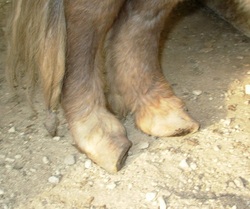
Diastrophia, translates into,
“twisted limb,” but is not always the case. It has been recorded in both miniature
horses and friesians. Diastrophia is characterized by twisted extremities, cow
hocks, ligament deformities, pot bellies, weak hind ends, and roach backs. The
main body of the diastrophic dwarf is often compacted due to the regular sized
organs and genitals, which results in a pot bellied appearance. Arthritis is
often seen in diastrophics at an early age. The legs of the diastrophic dwarf
are often longer than normally expected in dwarves.
Achondroplasia, the second type of
dwarfism, translates into, “short extremities.” Achondroplasia is the most
common form of dwarfism and is estimated to be in over 25-50% of miniature
horses. Achondroplasia dwarves have normal sized bodies and heads, but
noticeably smaller upper legs and ears. The backs of the Achondroplasia dwarf
are often longer than the normal miniature horse’s and their legs are sometimes
contracted and even have loose tendons. Achondroplasia dwarves are able to live
fairly normal lives but often times are afflicted with premature arthritis.
Brachiocephalia, the third type of
dwarfism, is the most popularly documented form of dwarf by popular culture
today. One of the most popular dwarves by popular culture is Thumbelina, who at
ten years old stands at seventeen and a half inches tall.
Brachiocephalia is a varied form of
dwarfism in the terms of expression. It can cause multiple defects at varied
extents. Individual dwarves may not express the same traits at the same
expression as another.
Brachiocephalia can cause misaligned
jaws, obstructed nasal passages, protruding roach backs, and ligament
disorders. Brachiocephalia dwarves often times have shorter life spans due to
heart and organ failure.
Hypochondrogenesis, the fourth type
of dwarfism, is the most fatal form of dwarfism. Hypochondrogenesis dwarves are
aborted before birth, often times before they reach the embryonic stage. The
foals many times have an exaggerated pot belly and cranium with short legs. The
bones of the hypochondrogenesis dwarf are not ossified. Hypochondrogenesis dwarfism
is thought to be caused by more than one form of dwarfism in one foal.
The birth of a dwarf foal is often
times an accident and unexpected. The parents of a dwarf foal must be carriers
of the dwarf gene. When bred together the offspring have a 25% chance of being
a non-carrier, a 50% of being a carrier, and a 25% of being a dwarf. Seventy
five percent of the time the dwarf gene will be passed on to their offspring.
The breeding of two carriers or dwarves of different types will never produce a
dwarf foal because of the lack of the same dwarf gene.
As a miniature horse breeder I began
researching equine dwarfism when my breeding stock continued to foal dwarves.
As of 2010, there have been six dwarf foals born: Simon, Trae, Boomer, Wendall,
Teddy, and Connor. As a miniature horse owner it is my duty to educate the
population of horse owners on the types and traits of dwarfism and also the
genetics surrounding it.
Sources:
"
Equine Dwarfism 101 - Horse Forums (HGS)." Horse Grooming Supplies. N.p., 8 Oct. 2010. Web. 17 Feb. 2011.
<http://www.horsegroomingsupplies.com/horse-forums/equine-dwarfism-101-a-361669.html>.
Jensen
, Janell . "Dwarf Horses." Angelfire: Welcome to
Angelfire. N.p., n.d. Web. 17 Feb. 2011.
<http://www.angelfire.com/ms3
Types of Dwarfism
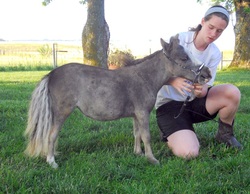 | Type 1: Diastrophia dwarf filly "Connor"
|
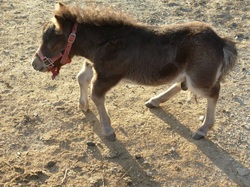 | Type 2: Achondroplasia dwarf colt "Trae"
|
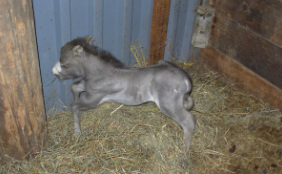 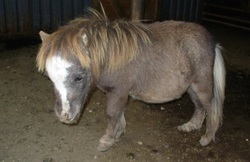  |
|
